ThermoTDR goes far beyond soil moisture — measuring bulk density, porosity, thermal conductivity and more, simultaneously, in situ, at a fraction of the cost.
Learn More ↓Conventional soil moisture sensors tell you one thing: how much water is in the soil. But understanding soil behaviour — infiltration, compaction, aeration, root growth — requires a much richer picture. Properties like bulk density, porosity, air-filled porosity and thermal conductivity are critical for soil process modelling, yet they typically require destructive sampling, expensive lab equipment, or separate instruments.
Coupled heat-water transfer models need thermal conductivity and heat capacity as inputs — not just water content. ThermoTDR provides these directly.
Tracking bulk density changes over time (compaction, tillage, settling) currently requires repeated coring. ThermoTDR does it continuously, non-destructively.
Air-filled porosity controls root aeration and gas exchange. Knowing it in real time alongside moisture opens new management possibilities.
By combining a heat pulse method with Time Domain Reflectometry in a single probe, ThermoTDR simultaneously determines:
These aren't independent instruments — they are derived from two complementary physics on the same soil volume: electromagnetic wave travel time for water content, and heat diffusion for thermal-structural properties.
This wasn't a paper exercise. We studied the underlying thermal physics, understood why the CPC model is mandatory for our probe geometry, designed and built custom hardware, wrote firmware and analysis software from scratch, ran dozens of test cycles, and produced a comprehensive peer-reviewed technical report. The conceptual and prototyping groundwork is complete.
Deep-dived into thermo-TDR literature. Understood why CPC model (not simpler ILS) is essential for large-diameter heaters. Mapped every parameter derivation chain.
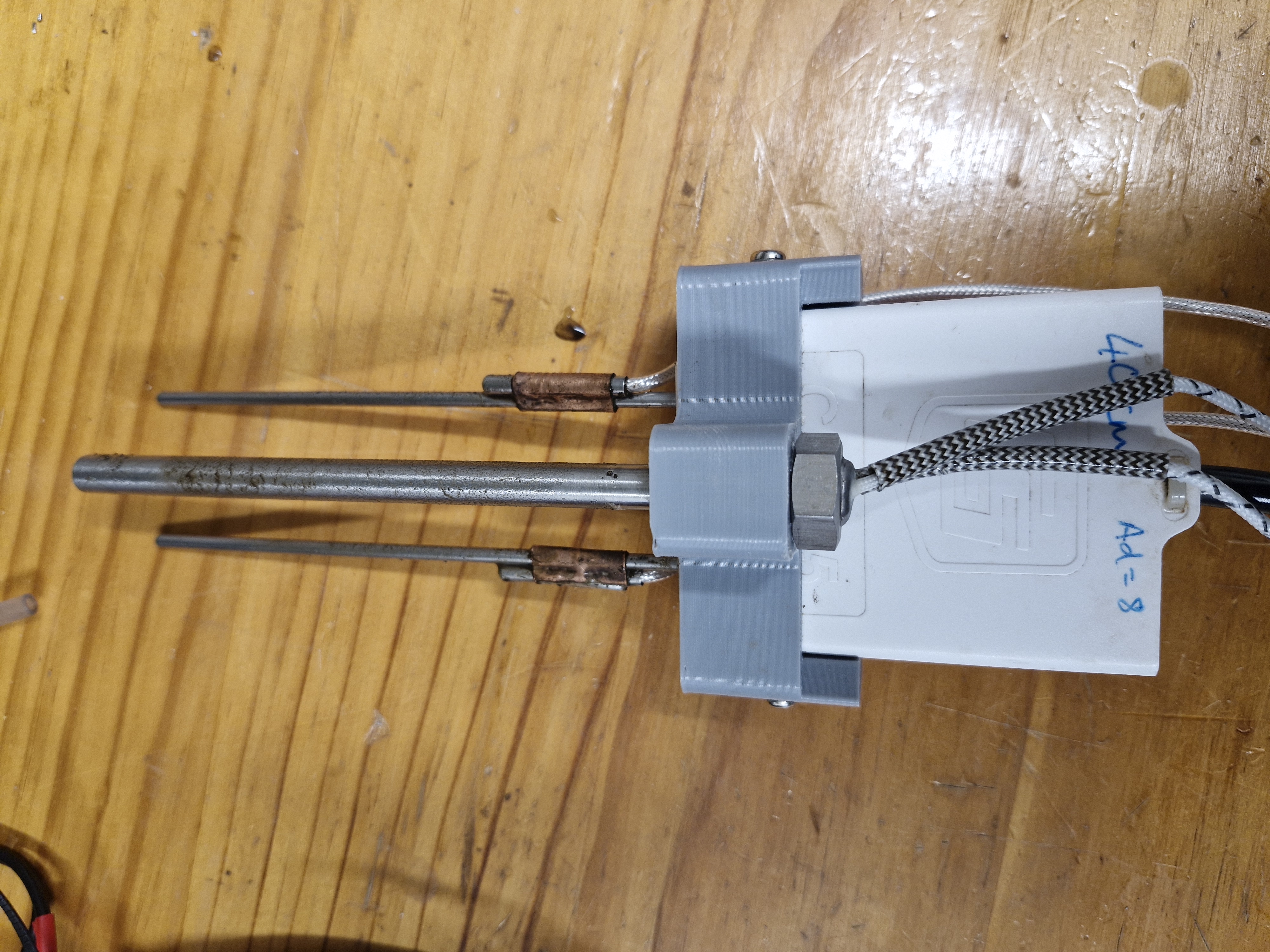
Designed and built a custom heater assembly piggybacked onto a CS655 TDR sensor. ESP32-S3 microcontroller with WiFi-based real-time data acquisition. Multiple design iterations.
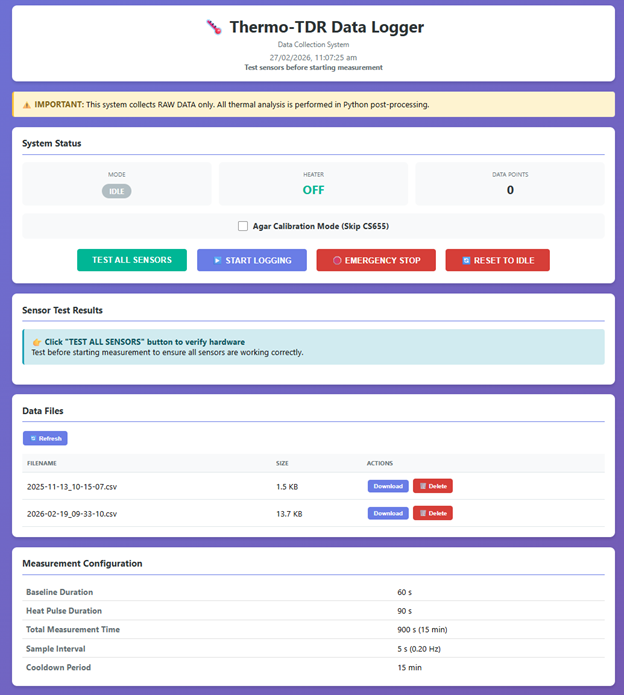
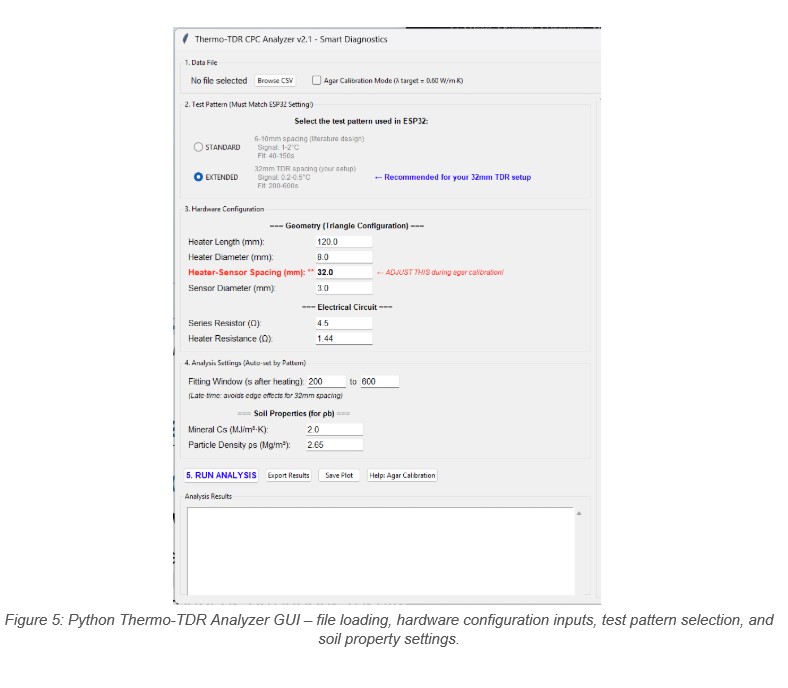
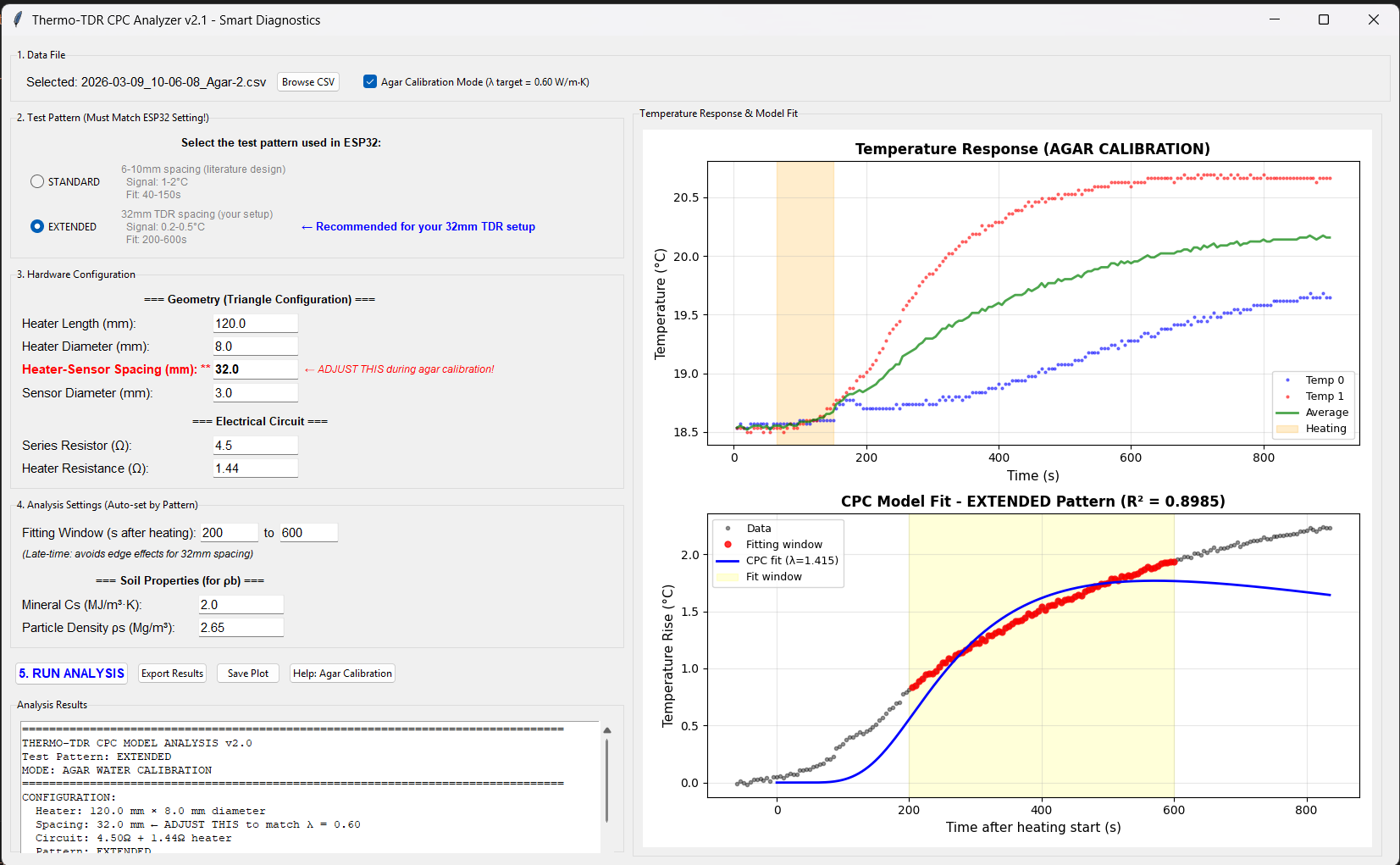
Full ESP32 firmware (FreeRTOS). Complete Python GUI analyser with CPC model fitting, parameter extraction, and quality diagnostics. All built from scratch.
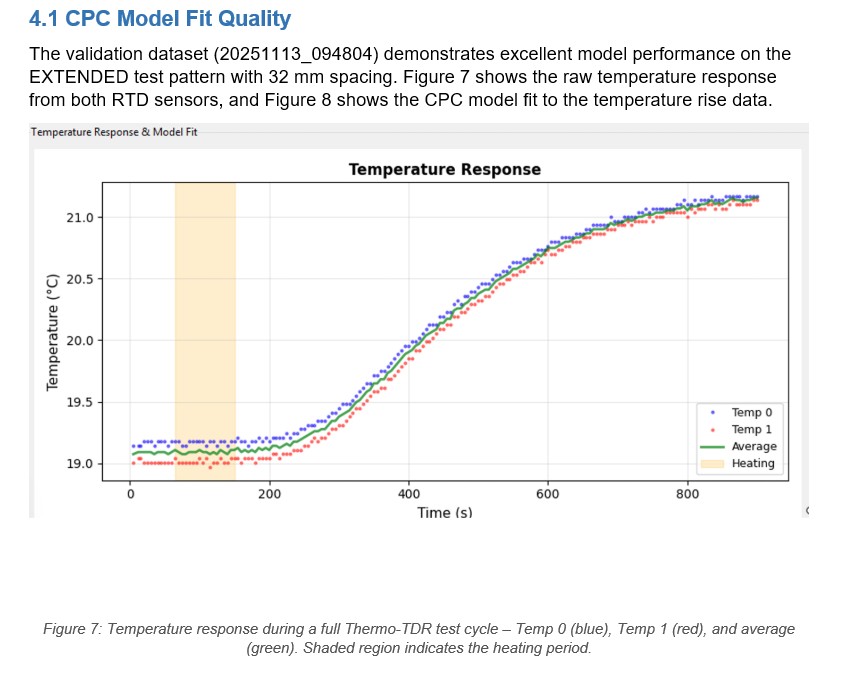
Soil tests with R² > 0.99 model fit. Agar calibration runs to characterise probe geometry. Iterative power and timing optimisation across multiple test cycles.
Comprehensive technical report with annexures, peer-reviewed by domain experts. Every design decision, limitation, and result transparently documented.
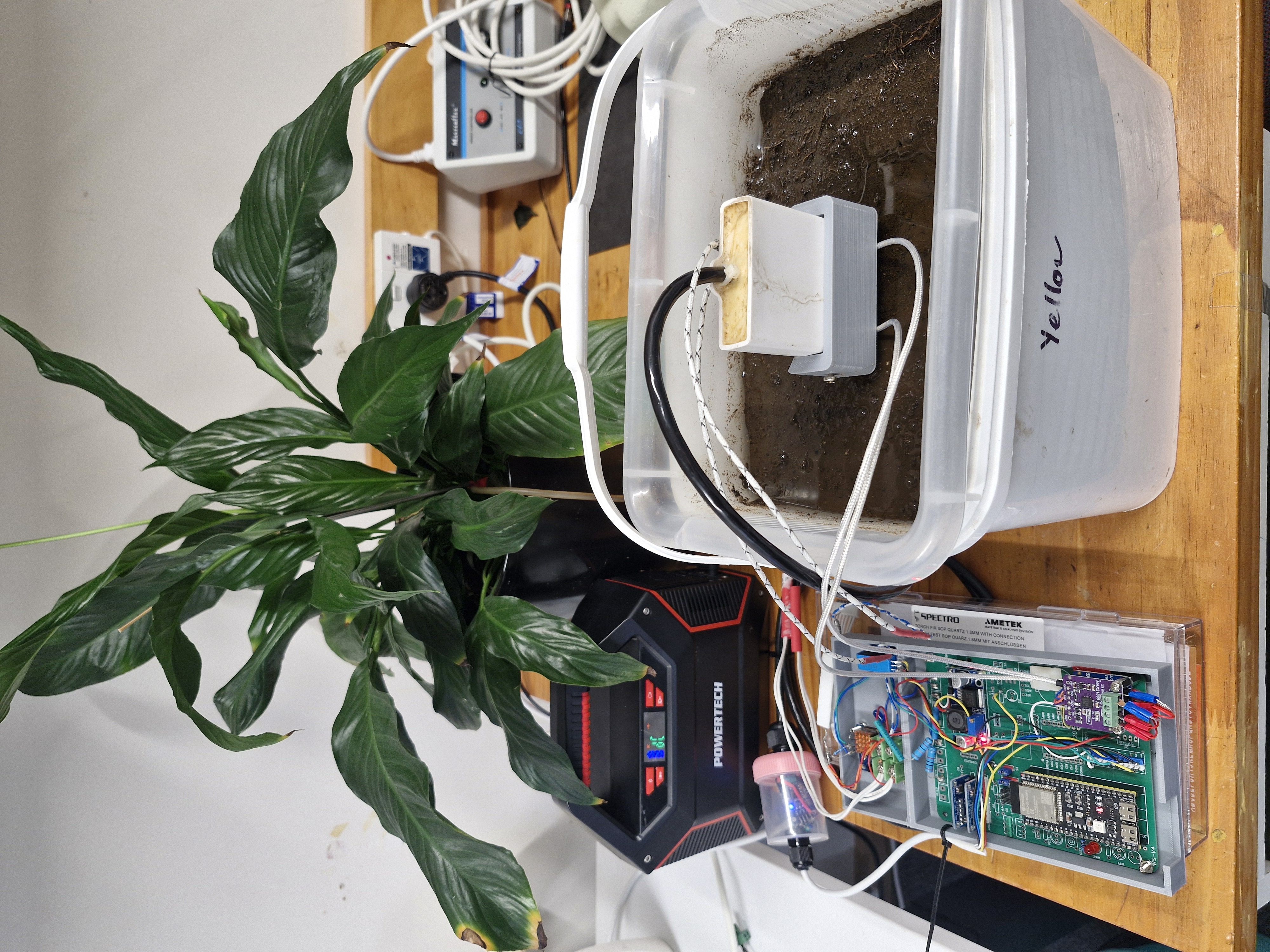
Hardware Assembly
CS655 + Heater Probe
ESP32 Web Interface
Python Analyser GUI
CPC Model Fit (R²=0.99)
Agar Calibration Setup
Click thumbnails to view full images
The science is validated. The next step is engineering a purpose-built sensor with optimised geometry — moving from proof-of-concept to a field-deployable instrument.
Design and fabricate a probe with standardised geometry — correct heater diameter, probe spacing, and length ratios aligned with published literature (e.g., 2.4 mm heater, 10 mm spacing, 70 mm length). This is the single most impactful improvement.
Either build TDR rods into the custom probe, or develop a robust attachment system for commercial sensors (CS655, SM300 etc.) — maintaining flexibility across platforms.
Rigorous calibration in reference media (agar, glass beads, known soils), followed by field validation across soil types. The optimised geometry will dramatically improve accuracy.
Long-term monitoring in real soil conditions — tillage effects, seasonal compaction, irrigation impacts — demonstrating the practical value for soil science and land management.
We are seeking support through Pan BSI (Better Start Initiative) or similar funding pathways to advance from proof-of-concept to a field-ready instrument. The core science is proven — what's needed now is targeted hardware engineering and testing.
This technology has the potential to transform how we monitor soil physical properties — making multi-parameter soil sensing accessible, affordable, and continuous.
Kishor Kumar · Landcare Research (Manaaki Whenua) · New Zealand